Project Lynx
On this page you can take an interactive look at our robot and learn more about the built-in sensors and components.
Loading 3D model …
Information: Please note that, depending on your device and internet connection, the 3D model may take longer to load, but it should not take more than 30 seconds. Drag with the mouse or your finger to rotate the model.
Power supply
The complete battery module was developed and built by our team.
Technical data (calculated):
- 16 LiFePO4 cells
- 16S1P configuration
- 5.376kWh – equivalent to 290 times the stored energy of a typical smartphone battery
- Continuous discharge power: 5.3kW
- Peak power: over 10kW
- Theoretical charging power: 5.3kW
- Practical charging power: 1.46kW (limited by the charger)
- Max. pack voltage: 58.4V
- Nominal voltage: 51.2V
- Weight: approx. 50kg
- Active clamping of the cells for optimal, permanent pressure
Additional features:
- Active smart ventilation with up to 10,000 revolutions per minute
- Heat dissipation through thermal pads onto the steel housing
- Sturdy housing made of sheet steel up to 10mm thick
- Clear view of the cells and electronics through acrylic glass
- Can be rolled through 360°
- Additional insulation of the cells from each other and from the housing
Drive
Motors
We used two DC servo motors
Technical data (according to the manufacturer):
- Rated power: 750W
- Rated voltage: 48VDC
- Rated torque: 2.39Nm
- Peak torque: 7.17Nm
- Rated current: 18.5A
- Rated speed: 3000rpm
- Torque constant: 0.129Nm/A
- Line-to-line resistance: 0.11ohms ± 10%
- Line-to-line inductance: 0.43mH ± 20%
- Inertia: 1.42kg·m²·10⁻⁴
- Encoder: 17-bit single-turn magnetic incremental encoder
- Poles: 10
- IP rating: IP65
Worm gear from Mädler
H/I, up to 226 Nm, i=7.5:1 to 100:1
Housing: die-cast aluminium. With mounting threads on the drive side and both output sides. With mounting holes on all other sides. Worm shaft: hardened and ground. Worm wheel: bronze on cast-iron hub. Lubrication: synthetic oil (lifetime fill). Lightweight, high-quality series in 5 sizes: centre distance 31.5, 40, 50, 63 and 75 mm. The gearboxes need no venting and can be installed in any position. Pluggable output shaft: in the basic version the gearboxes are hollow-shaft gearboxes.
You can find more information about the gearbox here.
© MÄDLER
Blade
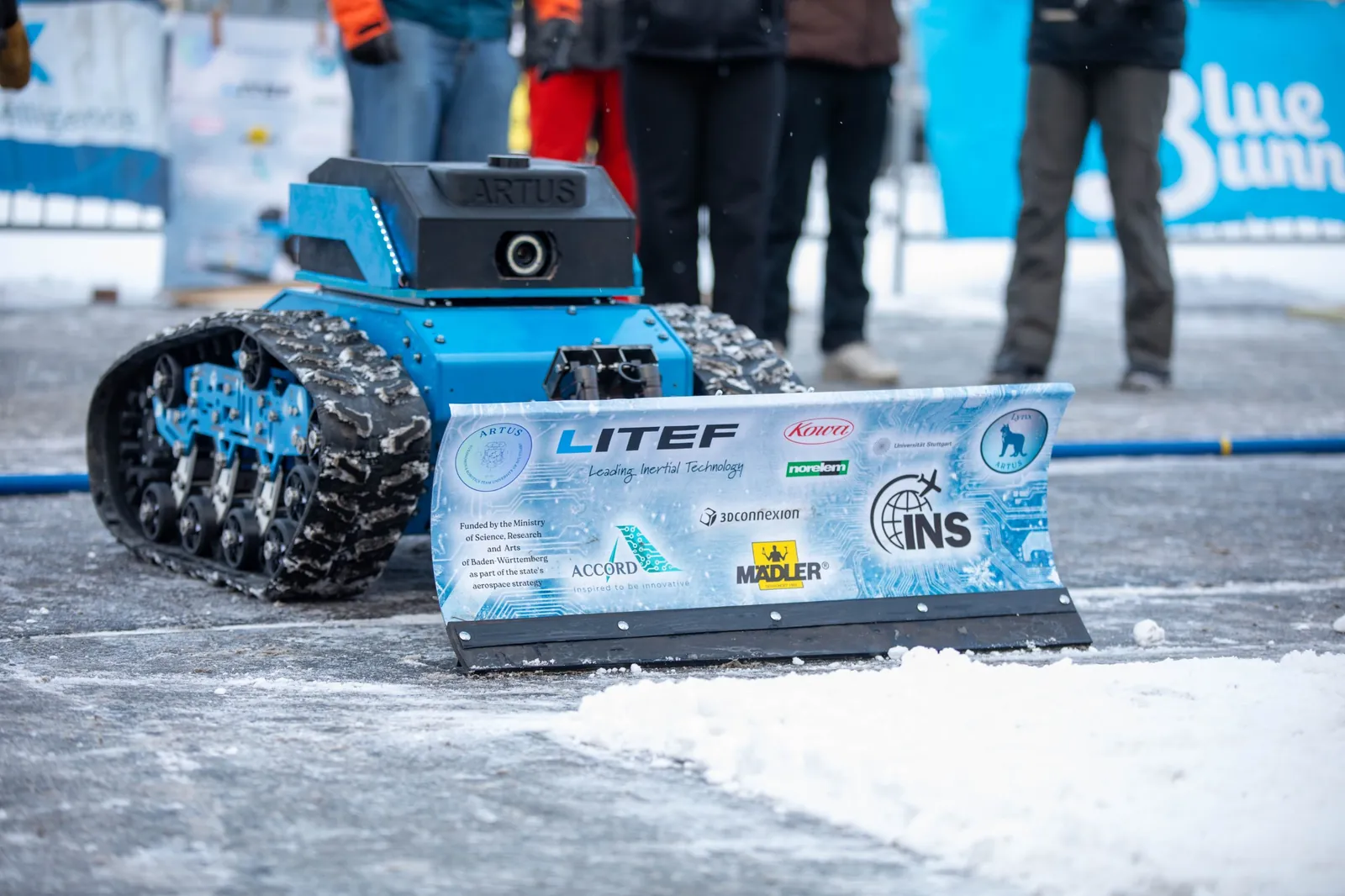
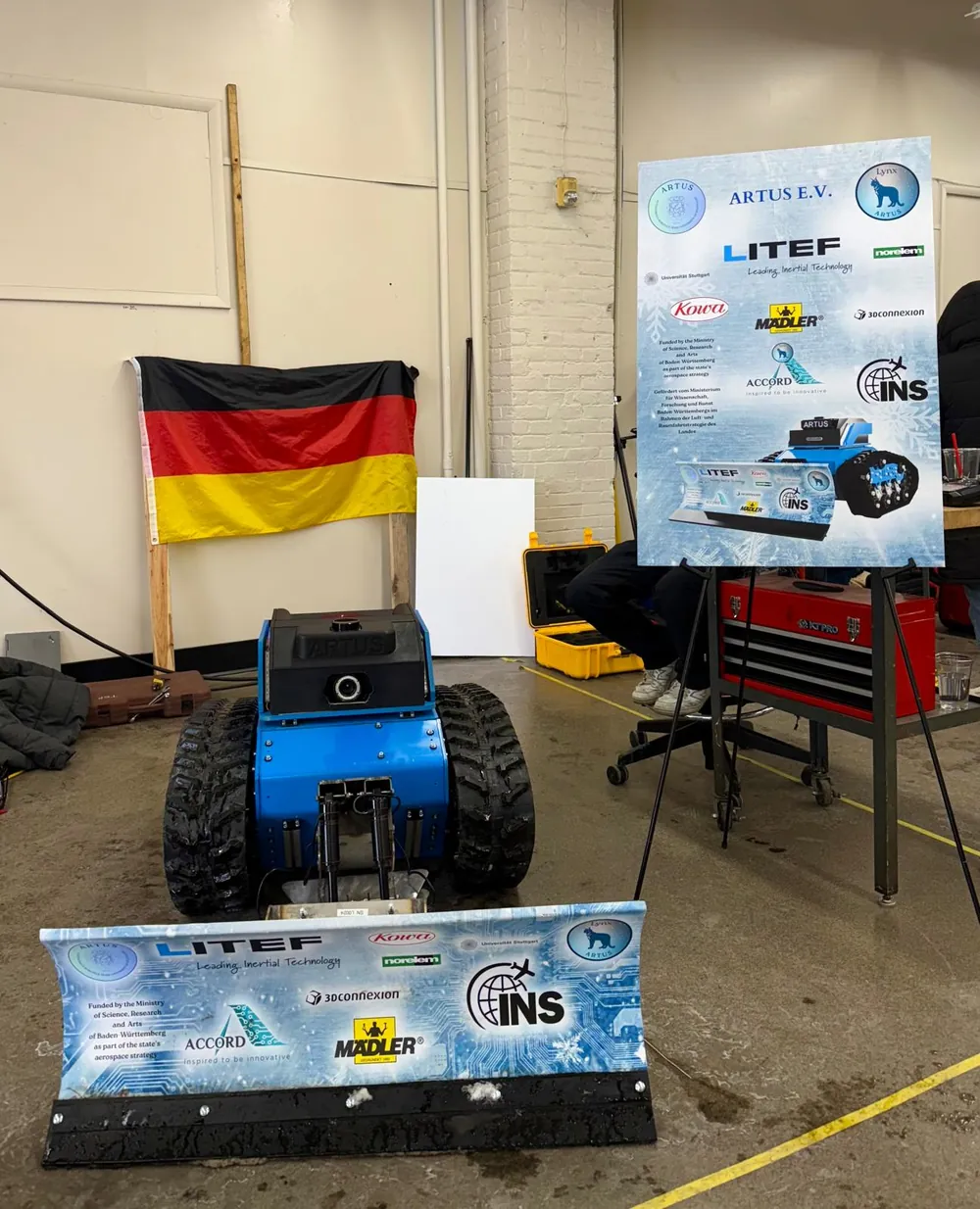
A two-axis adjustable snow blade is mounted as the payload; it can be moved both in height and sideways (left/right) and is driven by four linear motors.
Sensors
µIMU IC from LITEF
Attached to a freely moving object, the MEMS-based µIMU-IC from LITEF measures orientation, direction and speed in real time.
This allows our robot to be monitored precisely in order to enable accurate motion control. The µIMU-IC is particularly suited to demanding applications with rapidly changing environmental conditions, such as those at the Snow Plow Competition.
Technical data: these can be found here.
The MEMS-based µIMU is a complete inertial measurement unit and consists of three MEMS rate sensors, three MEMS accelerometers, the associated electronics and the power supply in a hermetically sealed, robust housing. With its small size, easy-to-integrate interface and excellent performance, the µIMU is the perfect measurement unit for all applications such as attitude reference systems and stabilisation systems, as well as for stabilising cameras, antennas and other instruments on moving platforms.
© LITEF
RGB camera with lens from Kowa
The KC300GC3CX camera:
The 3MP colour camera with a waterproof (IP67), dustproof, oil-resistant, shock- and vibration-proof housing.
Built for harsh environments in industrial image processing. This product is an industrial camera equipped with a global shutter, CMOS image sensor and GigE interface. Suitable for many applications such as robot vision. Perfectly suited to extreme environments with moisture, dust or oil.
The LM8JCM-WP ruggedized lens:
- The design of the lens is patented and it is a 2/3″ C-mount industrial lens with a focal length of 8mm.
- Suitable for sensors with a pixel size of 4.5μm and above.
- Developed for use in environments with strong vibrations and shocks
- A lock nut is used instead of screws to fix the focus
- All inner glass elements are bonded to increase stability
- IP67 waterproof when combined with a suitable camera
Technical data:
Camera – these can be viewed here.
Lens – these can be viewed here.
© Kowa
Depth camera
Technical data (according to the manufacturer)
- Depth technology: Active IR stereo
- Depth filter: All-pass
- Depth resolution: up to 1280 × 720 pixels
- Frame rate (depth): up to 90 frames/second
- Optimal working depth: 0.6 m – 6 m
- Minimum distance: approx. 0.52 m
- Depth accuracy: < 2% at 4 m
- Field of view (depth): 87° × 58°
- RGB resolution: up to 1280 × 800 pixels
- Frame rate (RGB): up to 30 frames/second
- Field of view (RGB): 90° × 65°
- Sensors: 3 × global
- Interface: USB 3.1 Type-C
- Protection class: IP65
LiDAR
Technical data (according to the manufacturer)
- Scan range: 360°, 2D
- Maximum range: 30 m (for white objects)
- Range (black objects): ≥10 m
- Blind zone: 0.05 m
- Measurement accuracy: ±30 mm
- Distance resolution: 13 mm
- Sampling rate: 32,000 measurements/second
- Scan frequency: 8–15 Hz (typically 10 Hz)
- Wavelength: 905 nm
- Laser class: Class 1 (eye safe)
- Interfaces: UART, USB adapter
- Supply voltage: 5 V
- Power consumption: <2.5 W
- Protection class: IP65
GNSS antenna and base station
Antenna element
Supported positioning signal bands:
- GPS: L1, L2
- GLONASS: G1, G2
- BeiDou: B1, B2
- Galileo: E1, E5b
- QZSS: L1, L2
- SBAS: WAAS, EGNOS, MSAS and GAGAN
Frequency range:
- 1559–1606 MHz
- 1197–1249 MHz
- Polarisation: RHCP (right-hand circular polarisation)
- Peak gain: 2.0 dBi (without ground plane)
- Axial ratio at zenith: < 3 dB
- Azimuth coverage: 360 degrees
- Average LNA gain: 28 dB
- Maximum noise figure: 3.2 dB
- Maximum VSWR: 2
- Protection class: IP67
GNSS module
Centimetre-level precision
- < 1 cm with base station up to 35 km away
- < 1 cm with NTRIP up to 35 km
- < 4 cm with SSR corrections
- < 1.5 m in standalone operation
- < 0.9 m standalone with SBAS coverage
- Update rate: standard: 1 Hz
- Maximum performance: up to 10 Hz
- With reduced performance: up to 20 Hz
- Multiband: supports L1, L2 and E5b
Multi-frequency and multi-constellation operation:
- GPS: L1C/A, L2C
- GLONASS: L1OF, L2OF
- Galileo: E1-B/C, E5b
- BeiDou: B1I, B2I
- QZSS: L1C/A, L2C
- SBAS: WAAS, EGNOS, MSAS, GAGAN, SouthPAN
Start-up times:
- First position fix: 25 seconds (cold start), 2 seconds (warm start)
- First RTK fix: 35 seconds (cold start)
- Data output: raw data in UBX format
- Base and rover function
Computing components
Central processing unit
Jetson Orin NX
- AI performance: up to 70 TOPS (Tera Operations Per Second) at configurable power consumption of 10 to 20 watts
- GPU: NVIDIA Ampere architecture with 1024 CUDA cores and 32 Tensor cores
- CPU: 6-core ARM Cortex-A78AE 64-bit CPU with max. 2 GHz clock frequency
- Deep learning accelerator (DLA): 1x NVDLA v2
- Vision accelerator: 1x PVA v2 (Programmable Vision Accelerator)
- Memory: 8 GB 128-bit LPDDR5 RAM with 102.4 GB/s bandwidth
- Video memory: 8GB LPDDR5, 128-bit, 102.4 GB/s
- Video interfaces: supports 1080p video decoding in multiple streams (e.g. 18 HD streams at 30 FPS)
- Storage: externally expanded – SSD 500GB up to 6,600 MB/s
Lynx at the Autonomous Snowplow Competition
At this year’s competition, our team placed fourth among a total of ten participating teams.
After the first run, we were even in second place. In the second run, two teams were still able to overtake us, so that we narrowly missed the podium in the end. Nevertheless, we are very satisfied with our performance, because it shows that our system is already at a high technical level and that we are clearly on the right track.
In addition, our project presentation and the competition poster were rated by the jury with the second-best result. We are particularly pleased with this result, as it confirms that we were convincing not only technically, but also in the professional presentation and communication of our work.
A very special moment was our team receiving the Dr. Nattu Sportsmanship Award. The award commemorates Dr. Nattu, a long-standing mentor and supporter of the competition who worked with great commitment for fairness, cooperation and mutual help between the teams. Accordingly, this award recognises not technical performance, but lived team spirit, helpfulness, respectful conduct and a positive attitude throughout the entire competition. For us, this award is a great honour and a valuable confirmation that ARTUS is not only technically strong, but also embodies, as people, the values that make up the spirit of the competition.